Tell us about the job
Takes about a minute. No obligation.
A boiler repair in Flathead County starts with a question about history: how many cycles have the burner and ignition system actually logged before this fault showed up. Homes in Flathead County, MT run heat about eleven months a year, from August through June. The heat exchanger, the ignition assembly, and the expansion tank all accumulate wear in proportion to how long the system runs, and a boiler here runs a long time. A contractor who skips that accounting risks replacing a single failed component while leaving a second one close behind it.
Piping that has been spliced, zone valves that were added after the original install, and aquastat settings left over from a previous boiler are what a contractor finds once the heat exchanger or circulator comes apart in many of these homes. Half the homes in Flathead County, Montana were built in 1991 or earlier (2020-2024 ACS 5-year). Stock built by then was plumbed for whatever was available at the time, and the systems running in those houses now are often a generation removed from what the pipes were first sized around. A repair quote that prices only the failed part can miss what is behind the boiler cabinet entirely.
The Parts of a Boiler a Contractor Checks First
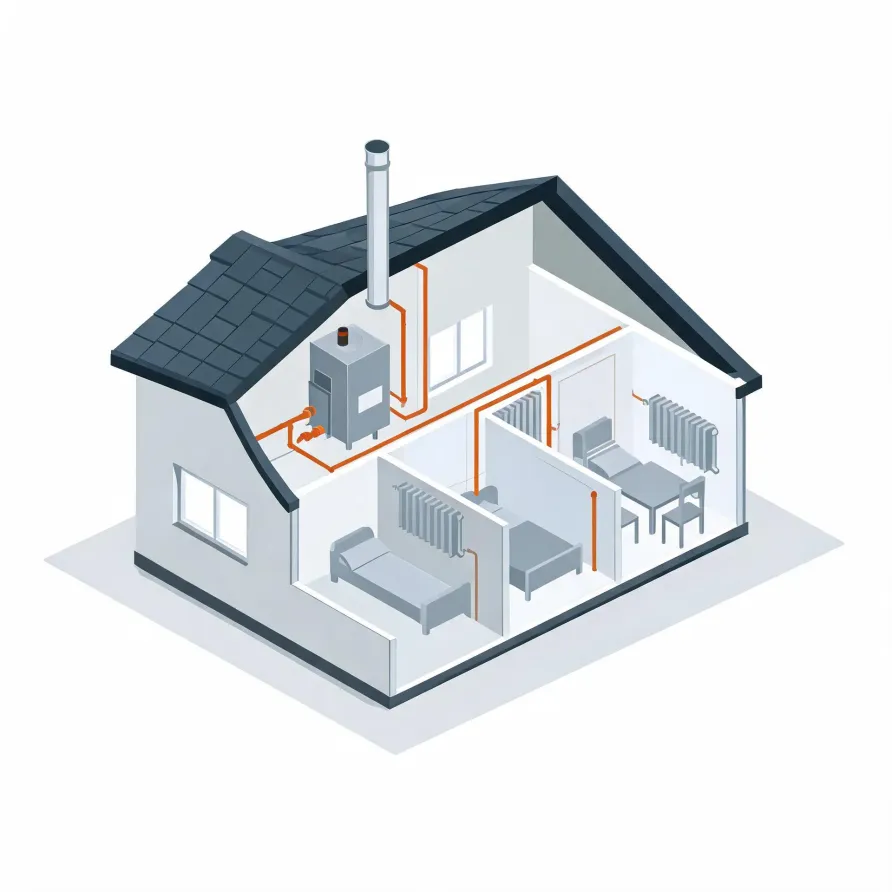
The boiler itself sits in a mechanical room, basement, or utility closet and is the piece a contractor goes to first. It heats water and sends it out through the system. When it fails, the signs range from no heat at all to uneven warmth across the house, and the fault can lie in the burner, the heat exchanger, or the controls built into the unit.
From the boiler, pipes carry hot water to radiators or baseboard units in each room, then return the cooled water back. The circulator pump keeps that water moving, and the expansion tank and pressure relief valve sit nearby to keep the system stable. Any of those points can be where a contractor finds the problem.
The drawing shows a typical boiler layout, and a licensed contractor determines which components and conditions apply to your specific home.
Find a contractor in Flathead CountyFlathead County, by the numbers
205 severe weather events were recorded in Flathead County, Montana between 2015 and 2024.
NOAA National Centers for Environmental Information, Storm Events Database, bulk CSV export, events 2015-01-01 through 2024-12-31.Half the homes in Flathead County, Montana were built in 1991 or earlier (2020-2024 ACS 5-year).
U.S. Census Bureau, 2020-2024 American Community Survey 5-Year EstimatesFlathead County, Montana holds 51,680 housing units (2020-2024 ACS 5-year).
U.S. Census Bureau, 2020-2024 American Community Survey 5-Year EstimatesOwners occupy 72.4% of the occupied homes in Flathead County, Montana (2020-2024 ACS 5-year).
U.S. Census Bureau, 2020-2024 American Community Survey 5-Year EstimatesBoiler Repair Rules & Standards for Flathead County, Montana2 sourced regulations and codes
Licensing and Legal Requirements in Flathead County, Montana
Montana’s contractor licence does not reach a casual, minor or inconsequential job whose total price for labour, materials and everything else is less than $2,500 — and the exemption is lost if the work is only part of a larger operation, or if a job is divided up to get under the figure.
Montana requires a current construction contractor licence from the Department of Labor and Industry: an individual or business may not engage in business as a construction contractor without one.
Severe Weather Events in Flathead County
Flathead County's weather puts real strain on boilers: hard cold snaps and storm cycles push heating systems through repeated stress, and failures tend to cluster around the same rough conditions. That pattern is local, which is why repair demand here follows what the weather does.
205 severe weather events, 2015–2024. Source: NOAA National Centers for Environmental Information, Storm Events Database.